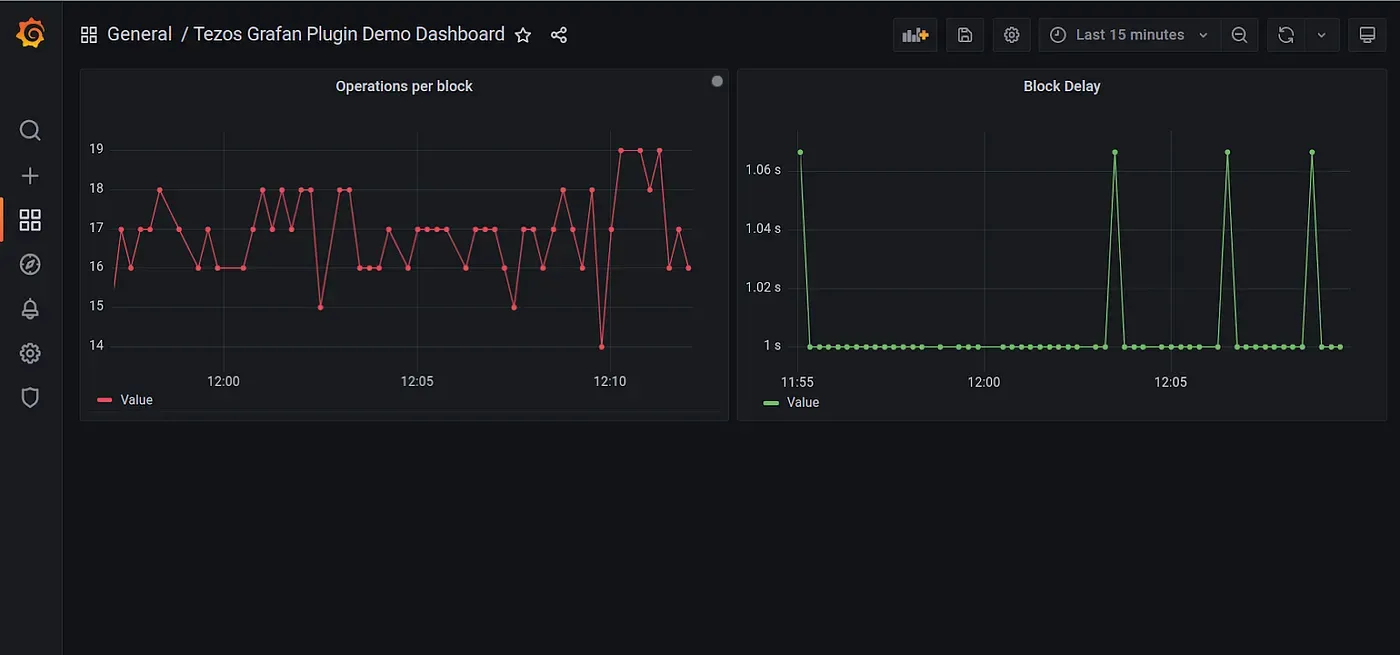
We have just made the initial release of our new Tezos Grafana Plugin. This plugin allows Grafana users to monitor Tezos RPC node and block level data. We use this plugin internally for testing and monitoring. At ECAD Labs the core dependency for all of our Tezos projects is the Tezos RPC node (typically Octez, but also TezEdge). This plugin was created to be another tool in our testing tool belt.
When testing in an environment that doesn’t have public indexers (such as mainnet or the long-lived testnets), it’s useful to have a tool that is quick to set up, and doesn’t have any external dependencies besides the system it is monitoring. We want to make the barrier to exploration and experimentation lower, and this plugin helps us with that end.
The Tezos Grafana plugin is written in go, and installed into a Grafana server as a plugin. The Grafana operator (the person configuring Grafana) can add a Tezos node’s RPC as a new data source. The Plugin will query this data source (the node), and cache that data in an internal datastore.
The Tezos Grafana Plugin is not a generalized indexer. Indexers are complex, deal with lots of data, are often slow to index, and they come with high operational expenses (OpEx). Not what we need to make quick observations. The Tezos Grafana Plugin is useful for inspecting block level data for relatively short time periods (a few minutes to a several hours). It can do larger time spans, but the plugin must get its data from the node by walking the chain. This is a relatively slow process. Thanks to the plugin’s internal data cache, it only needs to fetch data from the node once.
Presently, we are using the plugin to track block time delays on chain, and cross reference these delays with block processing delays associated with the specific node under our testing scrutiny. This allows us to observe the effect of RPC traffic on the node’s ability to process blocks in a timely manner.
If you are comfortable using Grafana and want to try the plugin out, head over to the setup instructions in our README. If you have questions, bugs or feature requests, use the GitHub Discussions page.
This plugin was created with funding from the Tezos Foundation, and we are grateful for their continuing support of our work to help expand and improve the Tezos ecosystem.